Štítky: somatická embryogeneze

Assessment of somaclonal variation in somatic embryo-derived plants of yacon [Smallanthus sonchifolius (Poepp. and Endl.) H. Robinson] using inter simple sequence repeat analysis and flow cytometry

Napsal uživatel Kateřina Eliášová dne Út, 13.02.2018 - 10:04

 Yacon (Smallanthus sonchifolius) is a root crop native to the Andean region. Low sexual reproductive capacity is a major constraint facing the genetic breeding of this crop. Biotechnological techniques offer alternative ways to widen genetic variability. We investigated somaclonal variation in regenerants of yacon derived from in vitro somatic embryogenesis using simple sequence repeat (ISSR) analysis and flow cytometry.
Interní autoři

Early molecular events involved in Pinus pinaster Ait. somatic embryo development under reduced water availability: transcriptomic and proteomic analyses

Napsal uživatel Kateřina Eliášová dne Út, 13.02.2018 - 09:52

Maritime pine somatic embryos (SEs) require a reduction in water availability (high gellan gum concentration in the maturation medium) to reach the cotyledonary stage. This key switch, reported specifically for pine species, is not yet well understood. To facilitate the use of somatic embryogenesis for mass propagation of conifers, we need a better understanding of embryo development.

Exogenous putrescine affects endogenous polyamine levels and the development of Picea abies somatic embryos

Napsal uživatel Zuzana Vondráková dne Út, 13.02.2018 - 09:44

Vondráková Z, Eliášová K, Vágner M, Martincová O, Cvikrová M:

Exogenous putrescine affects endogenous polyamine levels and the development of Picea abies somatic embryos. 

PLANT GROWTH REGULATION 75: 405-414, 2015.

The impact of UV-B irradiation applied at different phases of somatic embryo development in Norway spruce on polyamine metabolism

Napsal uživatel Milena Cvikrová dne Út, 13.02.2018 - 08:58

Higher polyamine levels of fully developed embryos had positive effects on their ability to tolerate UV-B irradiation when compared with induced response s of early embryos. The aim of this work was to test the hypothesis that the higher levels of polyamines (PAs) might be involved in the response of Norway spruce somatic embryos to UV-B irradiation. We compare here the effects of 0.1, 0.6 and 6 W m-2 h-1 UV-B irradiation on polyamine metabolism in early and fully developed Norway spruce somatic embryos.

Histological and biochemical response of Norway spruce somatic embryos to UV-B irradiation

Napsal uživatel Kateřina Eliášová dne Út, 13.02.2018 - 08:55

Key message The results of this study indicate the roles of polyamines and phenylpropanoids in the prevention of oxidative damage provoked by UV-B treatment. Abstract Plants respond to UV-B exposure by synthesizing a broad range of secondary metabolites, including ROSscavenging antioxidants and UV-B screening phenylpropanoids. Our recent results indicated that the accumulation of higher levels of polyamines in fully developed somatic embryos of Norway spruce may be causally linked to better tolerance of UV-B irradiation.

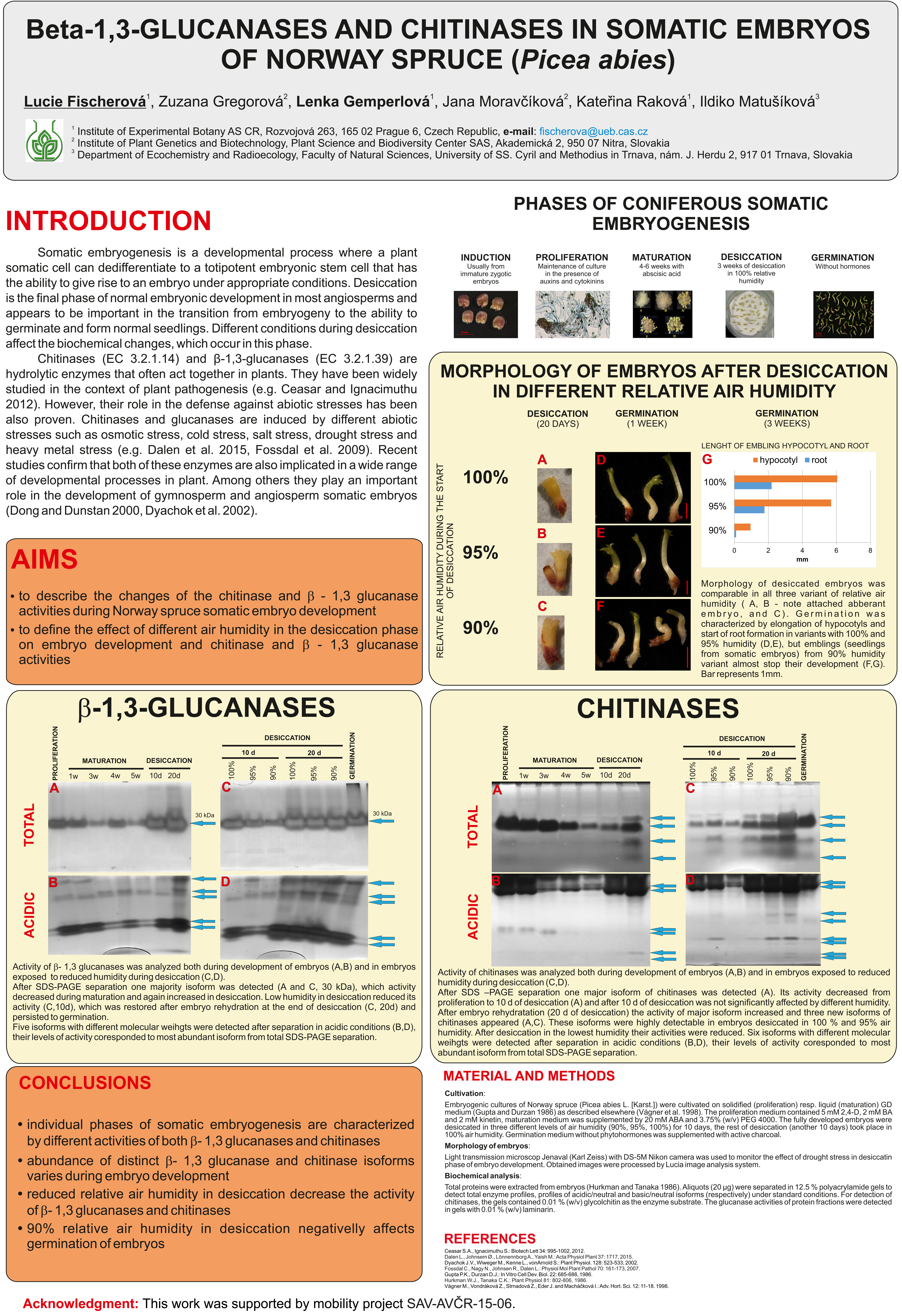
Beta-1,3-glucanases and chitinases in somatic embryos of Norway spruce

Napsal uživatel Lucie Fischerová dne Po, 12.02.2018 - 23:31

Somatic embryogenesis is a developmental process by which a plant somatic cell can dedifferentiate to a totipotent embryonic stem cell that has the ability to give rise to an embryo under appropriate conditions. Desiccation is the final phase of normal embryonic development in most angiosperms and appears to be important in the transition from embryogeny to the ability to germinate and form normal seedlings. Different conditions during desiccation affect the biochemical changes that occur during this phase.

Unbiased estimation of the proportion of non-embryogenic cell clusters in the somatic embryogenic culture of Douglas-fir

Napsal uživatel Kateřina Eliášová dne Po, 12.02.2018 - 23:26

Embryogenic cultures of Douglas-fir were induced from immature zygotic embryos. They proliferate as embryonal masses, however, in some lines of Douglas-fir, non-embryogenic cell (NECs) clusters interspersed with early somatic embryos (SEs) were observed. In order to evaluate the differences between lines we wanted to quantify the proportion of the SEs and NECs in the embryonal mass. For estimation of this proportion (volume density) we used stereological point-counting method based on counting points of the test grid falling in the tissue under study.

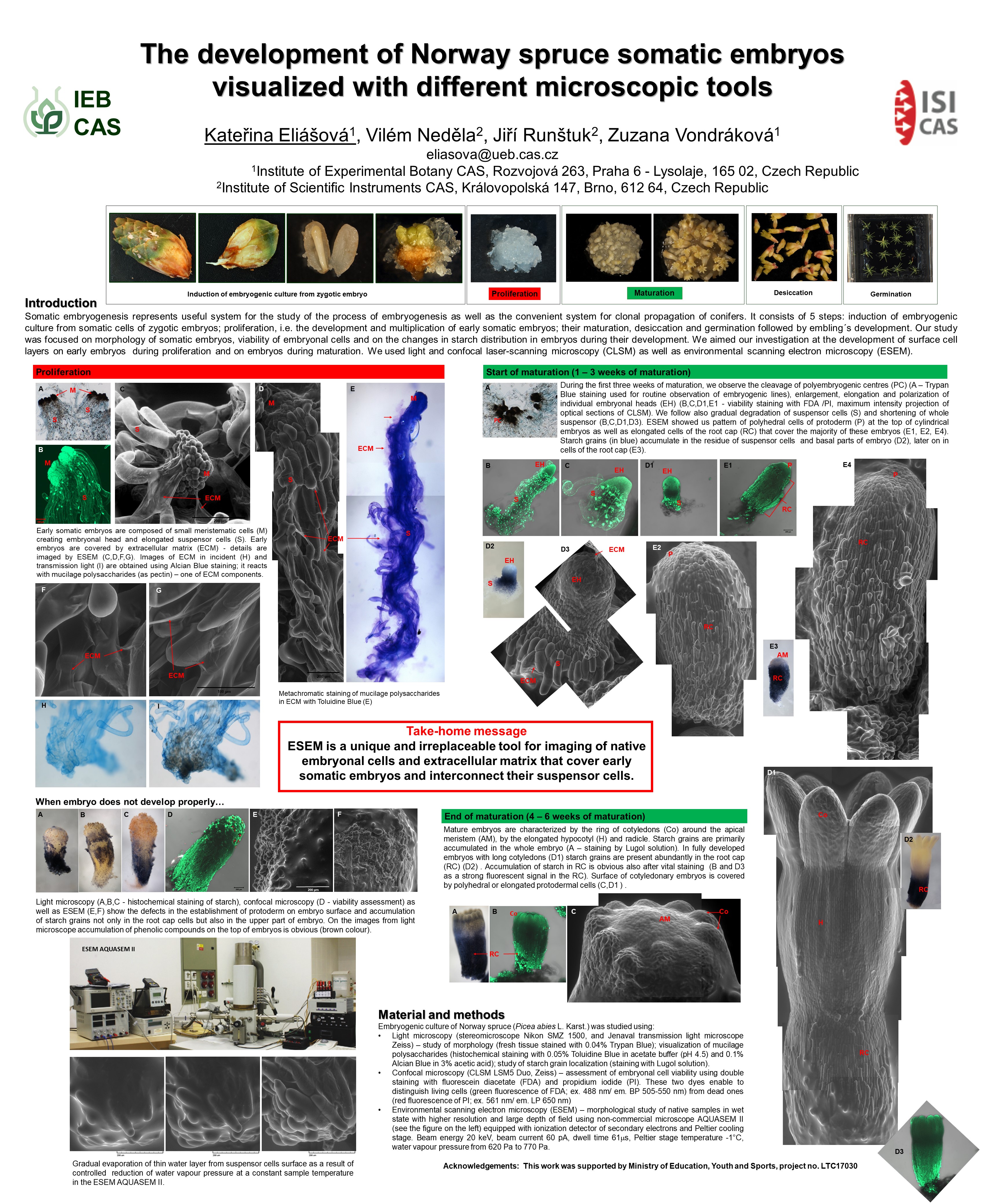
The development of Norway spruce somatic embryos visualized with different microscopic tools

Napsal uživatel Kateřina Eliášová dne Po, 12.02.2018 - 23:22

Somatic embryogenesis represents a useful system for the study of the process of embryogenesis as well as a convenient system for the clonal propagation of conifers. It consists of 5 steps: induction of embryogenic culture from somatic cells of zygotic embryos; proliferation, i.e. the development and multiplication of early somatic embryos; maturation, desiccation, and germination followed by embling´s development.

Endogenous phytohormone profiles during Norway spruce somatic embryogenesis

Napsal uživatel Zuzana Vondráková dne Po, 12.02.2018 - 23:13

Somatic embryogenesis (SE) in conifers is governed by a complex network of hormonal metabolic and signaling pathways. Changes in the patterns and concentrations of endogenous phytohormones including auxins, cytokinins (CKs), abscisic acid (ABA), jasmonates, and salicylic acid (SA) were analyzed in the course of SE in Norway spruce (Picea abies).