Štítky: somatická embryogeneze

Repetitive somatic embryogenesis induced cytological and proteomic changes in embryogenic lines of Pseudotsuga menziesii (Mirb.)

Napsal uživatel Kateřina Eliášová dne Út, 21.08.2018 - 11:54

This first report of cellular and molecular changes after repetitive somatic embryogenesis in conifers shows that each cycle enhanced the structure and singularization of EMs through modulation of growth regulator pathways, thereby improving the line´s embryogenic status.

Somatická embryogeneze smrku - proliferace nové embryogenní kultury

Napsal uživatel Kateřina Eliášová dne Pá, 05.03.2021 - 16:29

Nové buňky rostoucí na bývalém zygotickém embryu buď tvoří kalusy různých forem i barev nebo se diferencují na suspensorové a meristematické buňky raných somatických embryí a dávají základ nové embryogenní kultuře. 

Somatická embryogeneze smrku - indukce nových kultur

Napsal uživatel Kateřina Eliášová dne Pá, 05.03.2021 - 16:10

Nová somatická embryogenní kultura může vzniknout ze zygotického embrya kultivovaného in vitro na indukčním médiu . Důležitou roli v této fázi hrají fytohormony auxiny a cytokininy. 

Quantification of histochemical detection of polyphenolic compounds in somatic embryos of Norway spruce

Napsal uživatel Kateřina Eliášová dne St, 27.02.2019 - 16:54

Under standard cultivation conditions, Norway spruce somatic embryos (SEs) accumulate polyphenolic compounds mostly in the root cap. In response to UV-B, the accumulation of polyphenolics increases in protodermal cells and subprotodermal cortical cells and idioblasts in hypocotyl and cotyledons where they can attenuate UV-B stress. To quantify polyphenolic compounds accumulated in somatic embryos on the histological level resin sections were prepared, stained with Toluidine Blue.

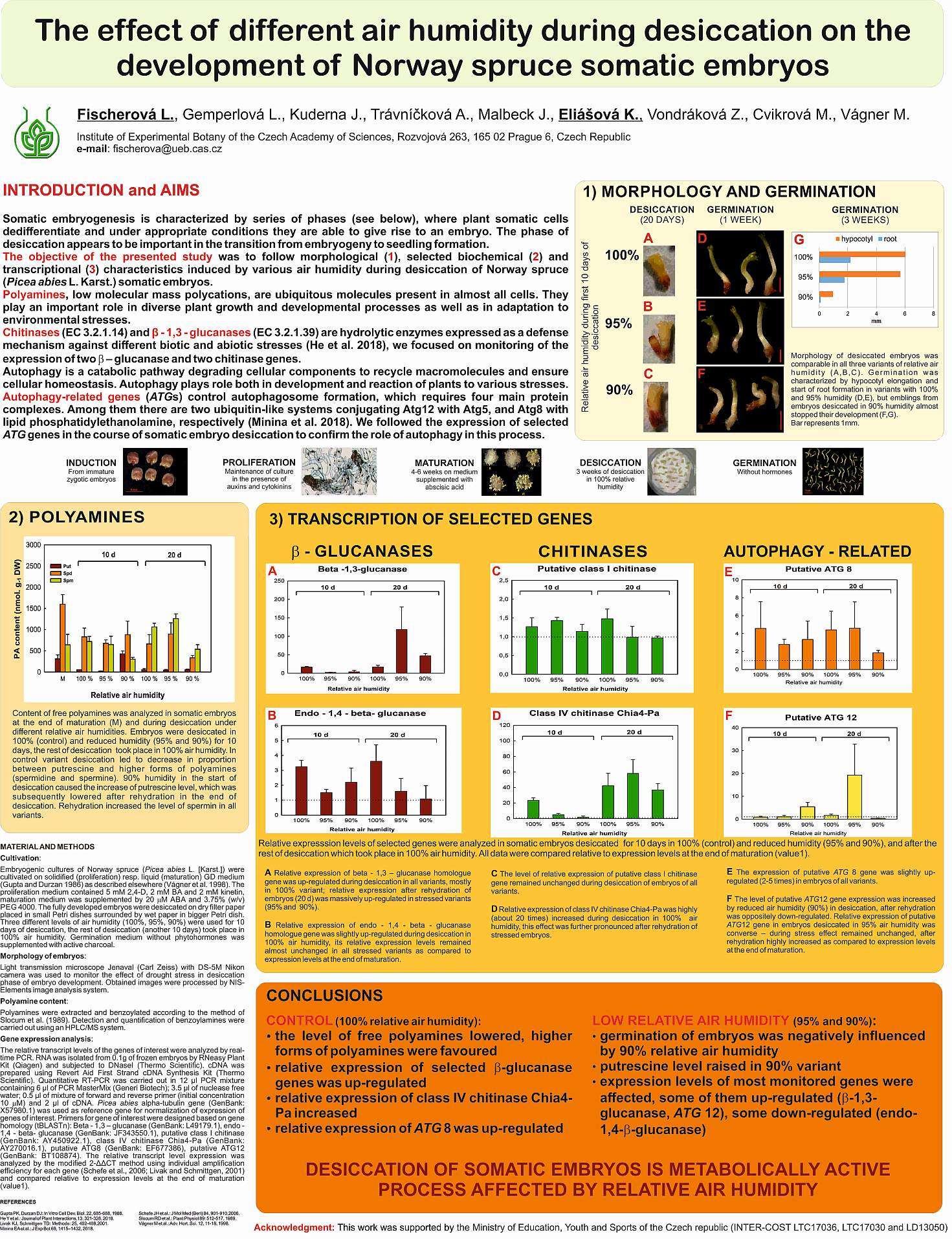
The effect of different air humidity during desiccation on the development of Norway spruce somatic embryos

Napsal uživatel Lucie Fischerová dne Pá, 21.09.2018 - 12:38

The objective of the study was to follow morphological, selected biochemical and transcriptional characteristics induced by various air humidity during desiccation of Norway spruce somatic embryos. The level of free polyamines lowered, higher forms of polyamines were favoured. Expression profiles of monitored genes were variously influenced by different relative air humidity. Our data proved, that desiccation of somatic embryos is metabolically active process highly affected by relative air humidity.

The effect of drought stress on Norway spruce somatic embryo development

Napsal uživatel Kateřina Eliášová dne Pá, 03.08.2018 - 11:51

Somatic embryogenesis is a developmental process where a plant somatic cell dedifferentiate to a totipotent embryonic stem cell that has the ability to give rise to an embryo under appropriate conditions. Desiccation is the final phase of normal embryonic development in most angiosperms and appears to be important in the transition from embryogeny to the ability to germinate and form normal seedlings.

Somatická embryogeneze jehličnanů

Napsal uživatel Kateřina Eliášová dne Út, 27.03.2018 - 13:32

Proces somatické embryogeneze rostlin umožňuje získat velké množství geneticky identických jedinců. V praxi se využívá k získání bohatého potomstva z minimálního množství semen. Zároveň je somatická embryogeneze ideálním systémem pro studium raných fází vývoje rostlin. Základním principem somatické embryogeneze je odvození embryogenní kultury většinou ze zygotických embryí a následně její kultivace in vitro na přesně definovaných médiích, jejichž složení určuje další vývoj somatických embryí.

What is the best way to maintain embryogenic capacity of embryogenic lines initiated from Douglas-fir immature embryos?

Napsal uživatel Kateřina Eliášová dne Út, 27.03.2018 - 12:16

Douglas-fir (Pseudotsuga menziesii (Mirb) Franco) is a native conifer from the Pacific North-West of the US and Canada, and is one of the most important timber species used in the world. Douglas-fir is highly productive in a range of climatic conditions and has valuable wood properties (quality) as well as a strong tolerance to diseases and insects. In Europe, Douglas-fir is a major species for reforestation with increasing demand for its wood. Adaptation of new varieties to climate change and associated stresses is one challenging question for ongoing breeding programs.